The Starry Night: Vincent van Gogh’s Vision of the Night Sky
The Starry Night is one of the best-known paintings in the history of art. Created by Vincent van Gogh in June 1889, it transforms a night sky into a vivid scene of swirling movement, brilliant stars and deep blue tones. Rather than offering a realistic record of the sky, the painting presents a powerful, personal vision of the world after dark.
A painting made in Saint-Rémy
Van Gogh painted The Starry Night while staying at the Saint-Paul-de-Mausole asylum in Saint-Rémy-de-Provence, in southern France. He had entered the institution in 1889, during a difficult period in his life. From his room, he could see the surrounding countryside, although the view in the painting does not simply reproduce what was before him. He combined observation, memory and imagination to create the scene.
The painting is now held by the Museum of Modern Art in New York. It is an oil painting on canvas and dates from a remarkably productive period in Van Gogh’s career.
A sky full of movement
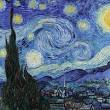
The most striking feature of the composition is its sky. Broad, curved brushstrokes sweep across the canvas, making the clouds appear to turn and flow. The moon and stars glow in rings of yellow and white, set against layers of rich blue. Their intense light gives the night an almost electric quality.
Below the sky, a quiet village sits in a valley. A tall church spire rises above its rooftops, while a dark cypress tree reaches upwards in the foreground. The contrast between the calm village and the restless sky gives the painting much of its emotional force.
Colour, brushwork and feeling
Van Gogh’s visible brushstrokes are central to the painting’s impact. They do more than describe shapes: they create rhythm, energy and atmosphere. The blues suggest the depth of night, while the warm yellows of the stars and moon draw the eye across the sky. The result feels both recognisable and dreamlike.
Viewers have interpreted The Starry Night in many ways, seeing in it themes of nature, longing, hope and inner turmoil. Van Gogh did not leave a definitive explanation of every detail, so these readings remain open to discussion. The painting’s lasting appeal may lie partly in this balance between a specific landscape and emotions that many people can recognise.
A lasting influence
Today, The Starry Night is celebrated for its distinctive style and its ability to make a familiar subject feel extraordinary. Its dramatic sky has influenced artists, writers and musicians, and it continues to attract visitors to the Museum of Modern Art.
More than a picture of a night sky, the painting is an invitation to look closely at the world and feel its movement. Van Gogh turned stars, rooftops and trees into a scene that is at once intimate and immense—a vision that continues to captivate audiences around the world.
9 Tips for a Brilliant Night of Stargazing
- Choose a clear, dry night.
- Head somewhere away from bright lights.
- Give your eyes 20 minutes to adjust.
- Bring a warm coat and a blanket.
- Use a red torch to protect night vision.
- Look for the Plough and other familiar patterns.
- Check a star map before you go.
- Bring a flask of tea or hot chocolate.
- Leave no litter behind.
Choose a clear, dry night.
Choose a clear, dry night to enjoy the stars at their best. Clouds can hide the sky, while damp or hazy conditions may make faint stars harder to see. Check the forecast before heading out, and if possible, choose a spot away from streetlights for a darker, clearer view.
Head somewhere away from bright lights.
For the best view of a starry night, head somewhere away from bright lights, such as a quiet rural area or a dark-sky site. Streetlights and buildings can make it harder to see faint stars, so give your eyes time to adjust to the darkness and avoid looking at your phone. Check the weather and moon phase beforehand, then look up and enjoy the sky.
Give your eyes 20 minutes to adjust.
Give your eyes about 20 minutes to adjust to the darkness before stargazing. In that time, your night vision gradually improves, making it easier to spot faint stars and details in the sky. Avoid bright lights, including your phone screen, as even a brief glance can undo much of that adjustment.
Bring a warm coat and a blanket.
Bring a warm coat and a blanket when you head out to enjoy a starry night. Temperatures can drop after dark, and staying cosy makes it easier to relax, take in the view and spend more time beneath the stars.
Use a red torch to protect night vision.
When enjoying a starry night, use a red torch to help protect your night vision. Red light is less disruptive than bright white light, so your eyes can stay adjusted to the darkness and you’ll be more likely to spot faint stars and details in the sky. Keep the torch dim and point it towards the ground when you need to see your way.
Look for the Plough and other familiar patterns.
When stargazing, look for the Plough, one of the easiest star patterns to recognise in the Northern Hemisphere. Its seven bright stars form a shape like a saucepan, making it a handy guide to finding other stars and constellations. Give your eyes time to adjust to the darkness, then scan nearby areas for familiar patterns such as Cassiopeia’s distinctive W. A clear, dark sky away from street lights will make the stars easier to spot.
Check a star map before you go.
Check a star map before you go stargazing to see which constellations, planets and other celestial sights will be visible from your location. A printed map or astronomy app can help you find your way around the night sky, and checking it in advance means you can spend less time searching and more time enjoying the stars.
Bring a flask of tea or hot chocolate.
Bring a flask of tea or hot chocolate to enjoy while you stargaze. A warm drink can help keep you cosy on a chilly night, making it easier to relax and take in the stars.
Leave no litter behind.
When enjoying a starry night outdoors, leave no litter behind. Take all rubbish with you, including food wrappers and drink containers, so the landscape stays clean and wildlife remains safe. Leave the place as you found it—or even tidier—for the next person to enjoy.