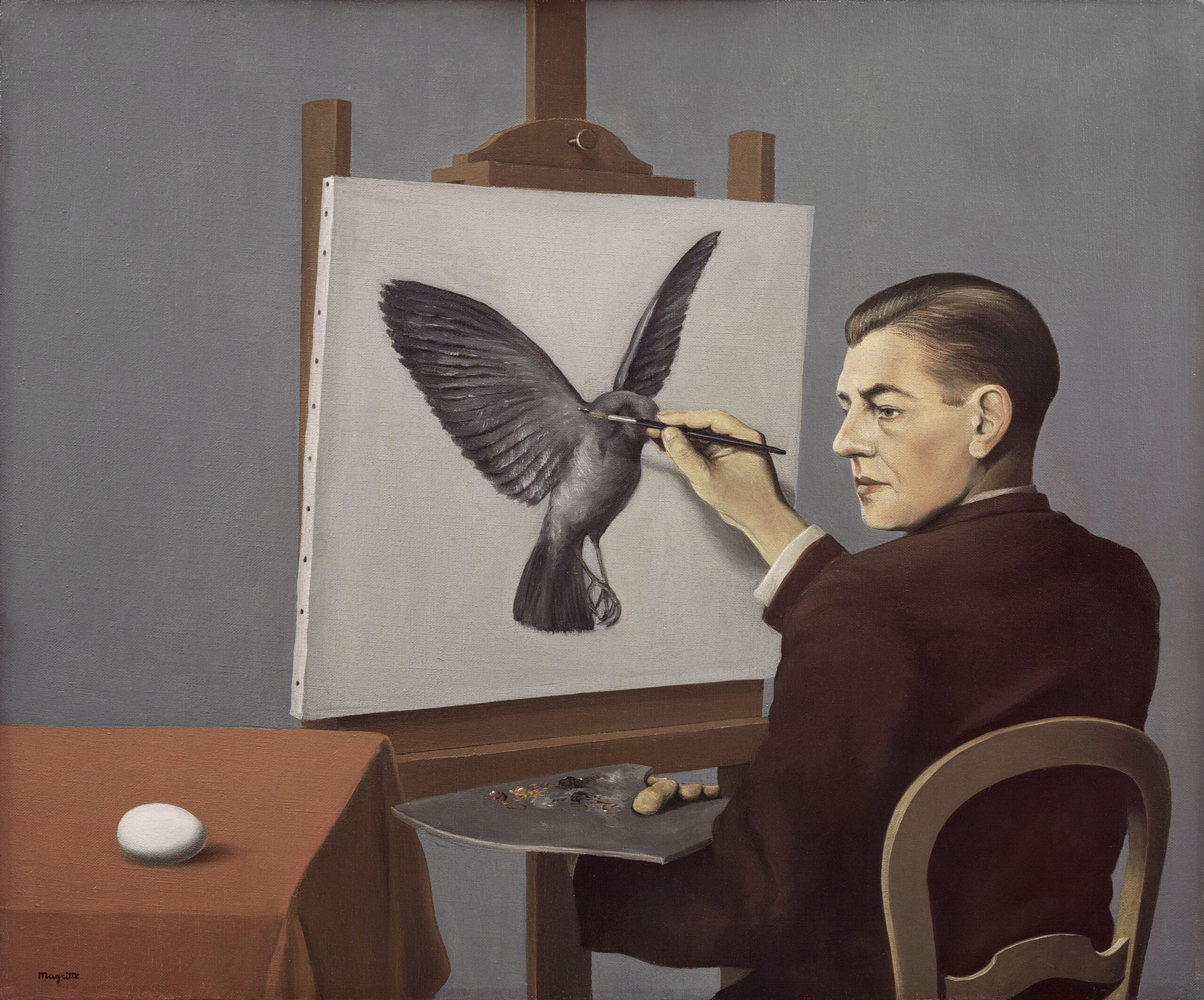
René Magritte: The Surrealist Who Made the Familiar Strange
René Magritte (1898–1967) was a Belgian artist whose paintings invite viewers to question what they see. A cloud might drift through a room, a face might be hidden by an apple, or an ordinary object might appear somewhere entirely unexpected. With his clear, carefully painted images, Magritte transformed everyday things into puzzles about perception, language and reality.
Life and artistic beginnings
Magritte was born in Lessines, Belgium, and studied at the Académie Royale des Beaux-Arts in Brussels. Before becoming established as an artist, he worked in commercial design, including producing posters and advertisements. That experience helped shape the precise, graphic quality of his paintings.
In the 1920s, Magritte became associated with Surrealism, an international movement that explored dreams, the unconscious and unexpected combinations of images. He spent time in Paris, where he met leading Surrealists, before returning to Brussels. Unlike artists who sought to depict dreamlike scenes through loose or expressive techniques, Magritte often painted with a smooth, realistic style. The strangeness lies not in the brushwork, but in what he asks familiar objects to do.
Images that question reality
One of Magritte’s best-known works is The Treachery of Images (1929), which shows a carefully rendered pipe above the words “Ceci n’est pas une pipe” — “This is not a pipe”. The statement points to a simple distinction: the painting is an image of a pipe, not an actual pipe. By drawing attention to the gap between an object, its image and the words used to name it, Magritte turns a familiar scene into a philosophical question.
He returned to similar ideas throughout his career. In The Son of Man (1964), a man in a bowler hat stands before a low wall and the sea, while a green apple obscures much of his face. The image is at once recognisable and frustratingly incomplete. In Golconda (1953), numerous identically dressed men appear to float or fall against a city backdrop, disrupting the ordinary rules of scale and movement.
Magritte also explored concealment, windows, skies and the relationship between objects and their surroundings. His Empire of Light paintings, made in several versions, bring together a nighttime street and a bright daytime sky. The two conditions seem impossible to experience at once, yet the scene is presented with the calm authority of a realistic landscape.
A distinctive approach to Surrealism
Magritte’s art is often witty, but it is not simply a collection of visual jokes. His paintings encourage people to look again at what they take for granted. A familiar object may become mysterious when it is removed from its usual setting; a realistic image may become unsettling when it contradicts its title or surroundings.
His influence can be seen far beyond the Surrealist movement. Artists, filmmakers, writers and designers have drawn on his memorable imagery and his interest in how pictures communicate. Magritte’s work remains popular because it is both accessible and open to interpretation: viewers can recognise the objects in his paintings, while still wondering what they mean.
A lasting legacy
René Magritte died in Brussels in 1967, but his paintings continue to challenge the boundary between what is real and what is represented. His achievement was not to make the ordinary disappear, but to reveal how strange it can become when seen from a different point of view.
René Magritte: 6 Frequently Asked Questions About His Life, Art and Meaning
- What are 3 interesting facts about Rene Magritte?
- What is René Magritte best known for?
- Why did Magritte hide faces?
- What is a famous quote by Rene Magritte?
- Where are Magritte’s most famous paintings?
- What is the meaning behind Magritte’s paintings?
What are 3 interesting facts about Rene Magritte?
Three interesting facts about René Magritte are that he worked as a commercial artist, designing posters and advertisements before becoming famous; his 1929 painting The Treachery of Images features a pipe and the words “This is not a pipe”, reminding viewers that a picture is only a representation of an object; and in The Son of Man, he famously concealed the face of a bowler-hatted man behind a floating green apple.
What is René Magritte best known for?
René Magritte is best known for his Surrealist paintings, which place familiar objects in unexpected or impossible situations to make viewers question reality, perception and language. His distinctive, precise style appears in celebrated works such as The Son of Man, with its apple-obscured face, and The Treachery of Images, which features the words “This is not a pipe” beneath a painted pipe.
Why did Magritte hide faces?
Magritte often hid faces to create mystery and make viewers question what they can know about a person from appearance alone. The concealed face in works such as The Son of Man turns a familiar portrait into something enigmatic, drawing attention to the tension between what is visible and what remains hidden. He also linked the motif to personal memories and recurring themes of concealment in his art, though it does not have one fixed meaning: its ambiguity is part of what makes the images so compelling.
What is a famous quote by Rene Magritte?
One of René Magritte’s best-known phrases is “This is not a pipe”, which appears in his 1929 painting The Treachery of Images beneath a painted pipe. The words are a playful reminder that an image of an object is not the object itself: the painting shows a representation of a pipe, rather than something that can be filled with tobacco and smoked.
Where are Magritte’s most famous paintings?
Magritte’s most famous paintings are held in museums and private collections around the world. The Magritte Museum in Brussels has a major collection of his work, while The Treachery of Images is at the Los Angeles County Museum of Art and Golconda is part of the Menil Collection in Houston. The Son of Man is privately owned and is not usually on public display, so its availability can vary. As Magritte made several versions of some subjects, works such as The Empire of Light can be found in different collections, including the Peggy Guggenheim Collection in Venice.
What is the meaning behind Magritte’s paintings?
Magritte’s paintings invite viewers to question the relationship between images, words and reality. By placing familiar objects in unexpected settings, concealing parts of a scene or pairing an image with a surprising title, he makes the ordinary seem mysterious. Rather than offering one fixed meaning, his work encourages people to look more closely and consider how perception shapes what they believe they see.