Marcel Duchamp: The Artist Who Changed the Meaning of Art
Marcel Duchamp (1887–1968) was a French-American artist whose ideas transformed modern art. Best known for his “readymades” — ordinary manufactured objects presented as works of art — Duchamp challenged audiences to reconsider what art could be and who had the authority to define it.
Early Life and Artistic Beginnings
Duchamp was born in Blainville-Crevon, France, into a family with a strong interest in the arts. He began painting in the early 1900s, experimenting with styles including Impressionism, Cubism and Fauvism. His work soon showed a willingness to question artistic conventions.
One of his best-known early paintings is Nude Descending a Staircase, No. 2 (1912). Combining repeated forms with a sense of movement, the painting caused a stir when it was exhibited in New York in 1913. Its fractured figure and dynamic composition reflected Duchamp’s interest in depicting motion and challenged traditional ideas of how the human body should be represented.
The Readymades
Duchamp’s most radical contribution was the readymade: an everyday object selected and presented as art. Rather than making an object by hand, he shifted attention to the artist’s choice and the context in which the object was displayed.
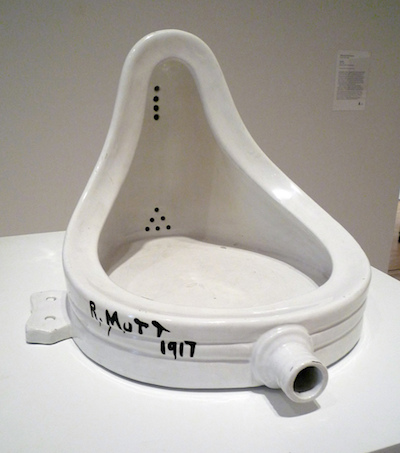
His most famous readymade is Fountain (1917), a porcelain urinal signed “R. Mutt”. Duchamp submitted it to an exhibition in New York organised on the principle that artists could display their work by paying a fee. The piece was rejected, prompting debate about artistic freedom, originality and the role of institutions. Although the original work is lost, authorised replicas were later made.
Other notable readymades include Bicycle Wheel (1913), which placed a bicycle wheel on a stool, and In Advance of the Broken Arm (1915), a snow shovel given a new title. These works encouraged viewers to see familiar objects differently and asked whether an idea or decision could itself be an artistic act.
Major Works and Ideas
Duchamp spent years developing The Bride Stripped Bare by Her Bachelors, Even, commonly known as The Large Glass (1915–1923). Made from glass, wire, foil and other materials, it combines mechanical forms with enigmatic imagery. Duchamp described it as unfinished in 1923, after the glass was accidentally cracked; he later accepted the cracks as part of the work.
Humour, wordplay and ambiguity run throughout Duchamp’s art. His work often resists a single interpretation, inviting viewers to take an active part in making meaning. This approach was closely associated with Dada, an international movement that rejected conventional ideas of culture and artistic taste, particularly in the aftermath of the First World War.
Chess and Later Life
From the late 1920s, Duchamp devoted much of his time to chess, competing in tournaments and representing France in international events. Chess was more than a pastime for him: its patterns, rules and possibilities appealed to his interest in thought and strategy. He continued to make art, though often privately and at a measured pace.
One of his final major works, Étant donnés (1946–1966), was assembled in secret and revealed after his death. Visitors look through two small openings in a wooden door to see a carefully constructed scene. The work demonstrates Duchamp’s continuing interest in perception, spectatorship and the boundaries between what is seen and what remains hidden.
A Lasting Influence
Duchamp’s influence can be seen in conceptual art, installation, performance and many later forms of contemporary practice. By questioning the importance of craft, beauty and originality, he helped shift attention towards ideas, choices and the systems through which art is recognised.
More than a century after Fountain was first presented, Duchamp’s work continues to provoke discussion. His enduring legacy lies not simply in the objects he made, but in the questions he left behind: what makes something art, how does context shape meaning, and what role does the viewer play?
Marcel Duchamp: Six Key Facts About the Artist Who Redefined Art
- Marcel Duchamp was a French-American artist born in 1887.
- He was a leading figure in Dada, an anti-establishment art movement.
- His famous work *Fountain* was a signed urinal submitted in 1917.
- He called everyday objects presented as art “readymades”.
- His painting *Nude Descending a Staircase, No. 2* blends movement and Cubism.
- Duchamp later devoted years to creating the secretive work *Étant donnés*.
Marcel Duchamp was a French-American artist born in 1887.
Marcel Duchamp was a French-American artist born in 1887, widely regarded as one of the most influential figures in modern art. He challenged traditional ideas about creativity and what could be considered art, most famously through his “readymades” — everyday objects he selected and presented as artworks. His bold ideas helped shape Dada and conceptual art, and continue to inspire artists today.
He was a leading figure in Dada, an anti-establishment art movement.
Marcel Duchamp was a leading figure in Dada, an anti-establishment art movement that emerged during the First World War. Dada artists challenged traditional ideas of art, taste and cultural authority, often using absurdity, chance and unconventional materials. Duchamp’s readymades—ordinary objects presented as art—captured this spirit, prompting audiences to question what art is and who gets to decide.
His famous work *Fountain* was a signed urinal submitted in 1917.
Marcel Duchamp’s famous work Fountain was a porcelain urinal signed “R. Mutt” and submitted to an art exhibition in New York in 1917. By presenting an everyday manufactured object as art, Duchamp challenged conventional ideas about creativity, originality and what could be exhibited as a work of art.
He called everyday objects presented as art “readymades”.
Marcel Duchamp called everyday, mass-produced objects presented as works of art “readymades”. By selecting an object and placing it in an artistic context, he challenged traditional ideas about creativity, craftsmanship and what could be considered art. His readymades invited viewers to look at familiar things differently and consider how an artist’s choice can shape meaning.
His painting *Nude Descending a Staircase, No. 2* blends movement and Cubism.
Marcel Duchamp’s painting Nude Descending a Staircase, No. 2 (1912) combines Cubist forms with a striking sense of movement. Rather than depicting the figure in a single, frozen pose, Duchamp uses overlapping shapes and repeated lines to suggest a body moving down a staircase. The result challenged traditional ways of representing the human figure and helped make the painting one of his most celebrated early works.
Duchamp later devoted years to creating the secretive work *Étant donnés*.
Duchamp spent roughly twenty years creating *Étant donnés*, a mysterious installation that remained hidden from the public during his lifetime. Completed in 1966, the work can be viewed only through two small openings in a wooden door, where visitors see a carefully constructed scene. Its secretive presentation reflects Duchamp’s lasting interest in perception, spectatorship and the boundary between what is revealed and what remains unseen.