Kintsugi: The Art of Repairing Broken Pottery
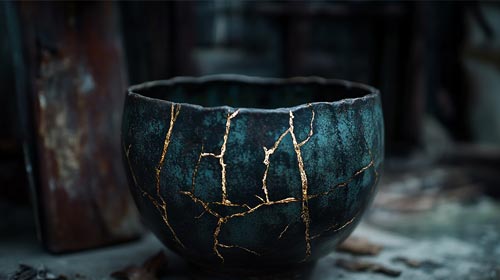
Kintsugi is a traditional Japanese technique for repairing broken ceramics. Rather than concealing cracks, it highlights them with lacquer and powdered metal, often gold. The result is a piece that bears visible traces of its history: breakage becomes part of its appearance rather than something to hide.
How kintsugi works
In a traditional repair, the broken edges of a ceramic object are joined using urushi, a natural lacquer made from the sap of the urushi tree. Once the repair has cured, the seams may be finished with finely powdered gold or another metal. The process takes patience: urushi needs time and carefully controlled conditions to harden, and several stages of repair and finishing may be required.
Kintsugi is not simply a decorative coating applied over a crack. It is a skilled craft that restores an object and gives its damage a distinctive place in its design. Different repair methods can produce varied results, from fine, delicate lines to more prominent joins.
A practice with a long history
Kintsugi developed in Japan as a way to repair valued ceramics, including tea bowls. Its history is often linked to the Japanese tea ceremony, where objects are appreciated for their character and use as well as their appearance. The technique has evolved over time, and its precise origins are not entirely clear.
The word kintsugi is commonly translated as “golden joinery”. It is also known as kintsukuroi, often rendered as “golden repair”. The names point to the central idea: a repair can be visible, considered and beautiful in its own right.
More than a metaphor
Kintsugi is often associated with the Japanese aesthetic of wabi-sabi, which finds beauty in imperfection, change and the marks of time. It is also widely used as a metaphor for resilience: a person, community or object may be altered by hardship without losing its value.
That interpretation can be meaningful, but it is a modern way of explaining the practice and should not be mistaken for a single, universal statement of Japanese philosophy. Kintsugi is first and foremost a practical craft, shaped by materials, skill and the particular object being repaired.
Kintsugi today
Contemporary artists and craftspeople continue to use traditional techniques, while workshops and modern repair kits have introduced kintsugi to new audiences. Some kits use synthetic adhesives or imitation metallic finishes rather than traditional urushi and gold. These can offer an accessible introduction, but they are not identical to traditional materials or methods.
Safety matters when repairing objects intended for food or drink. Urushi can cause an allergic skin reaction while uncured, and not every modern repair product is suitable for contact with food. Anyone planning to use a repaired piece should check the materials and the maker’s guidance.
The beauty of a visible repair
Kintsugi offers a different way to think about repair. Instead of treating damage as something to erase, it makes the act of mending part of an object’s story. Each finished piece is unique, shaped by the original break, the repairer’s decisions and the marks left by time.
Kintsugi FAQs: Cost, Pronunciation and Meaning in Love and Christianity
- Why is kintsugi so expensive?
- What does the kintsugi symbolize?
- What does kintsugi symbolize?
- How is kintsugi pronounced?
- What does the Bible say about kintsugi?
- What does kintsugi mean in Christianity?
- What does kintsugi mean in love?
Why is kintsugi so expensive?
Kintsugi can be expensive because traditional repairs are painstaking and highly skilled, often involving several stages of joining, lacquering, curing and polishing. Urushi lacquer takes time to harden, while genuine gold or other precious-metal powders add to the materials cost. Each piece also needs individual attention, as the repair must follow its unique breaks and shape. The price therefore reflects the craftsperson’s expertise, the time involved and the materials used.
What does the kintsugi symbolize?
Kintsugi symbolises the value of repair, renewal and the history an object carries. By highlighting rather than hiding cracks, the Japanese art of mending pottery suggests that damage need not diminish beauty or worth. It is often used as a metaphor for resilience and embracing imperfection, though its meaning can vary between people and contexts.
What does kintsugi symbolize?
Kintsugi is often seen as a symbol of resilience, renewal and the beauty of imperfection. By highlighting rather than hiding the repaired cracks in pottery, it suggests that damage and change can become part of an object’s history without diminishing its value. The idea is sometimes applied to human experiences, too, though kintsugi is first and foremost a traditional Japanese craft.
How is kintsugi pronounced?
Kintsugi is commonly pronounced “kin-TSOO-gee”, with the emphasis on the second syllable. The Japanese word is written 金継ぎ and means “golden joinery” or “golden repair”. Pronunciation can vary slightly between English speakers, but “kin-TSOO-gee” is a helpful guide.
What does the Bible say about kintsugi?
The Bible does not mention kintsugi, which is a Japanese pottery-repair technique, but some people use it as a metaphor for healing and restoration. They may connect its visible repairs with passages such as Psalm 147:3, which speaks of God healing the brokenhearted, or 2 Corinthians 4:7, which describes treasure held in “jars of clay”. These are thoughtful comparisons rather than direct biblical teachings about kintsugi.
What does kintsugi mean in Christianity?
Kintsugi is a Japanese pottery-repair tradition, not a Christian practice, so it has no established meaning in Christian teaching. Some Christians use its visible golden seams as a personal metaphor for healing, grace or finding hope after hardship, but that is a modern interpretation rather than a traditional religious symbol.
What does kintsugi mean in love?
In love, kintsugi is often used as a metaphor for repairing a relationship after difficulty. Like a broken vessel mended with visible golden seams, a couple may acknowledge hurt, work through it together and build a bond shaped by greater honesty and understanding. It does not mean that every relationship should be repaired, or that pain is automatically made beautiful; trust, respect and mutual effort matter.