Keith Haring: Art for Everyone
Keith Haring was an American artist whose bold lines, energetic figures and instantly recognisable symbols brought art beyond galleries and into public spaces. During a career that lasted little more than a decade, he created paintings, murals and sculptures that explored community, love, power and social responsibility.
From Pennsylvania to New York
Haring was born in Reading, Pennsylvania, in 1958 and grew up in nearby Kutztown. He developed an early interest in drawing, encouraged by his father, who made cartoons. After studying commercial art in Pittsburgh, he moved to New York City in 1978 and enrolled at the School of Visual Arts.
New York’s street culture and lively arts scene shaped his work. In the early 1980s, Haring began drawing with white chalk on the black paper used to cover empty advertising spaces in subway stations. These quick, public works attracted the attention of commuters and helped establish his distinctive visual language.
A bold visual language
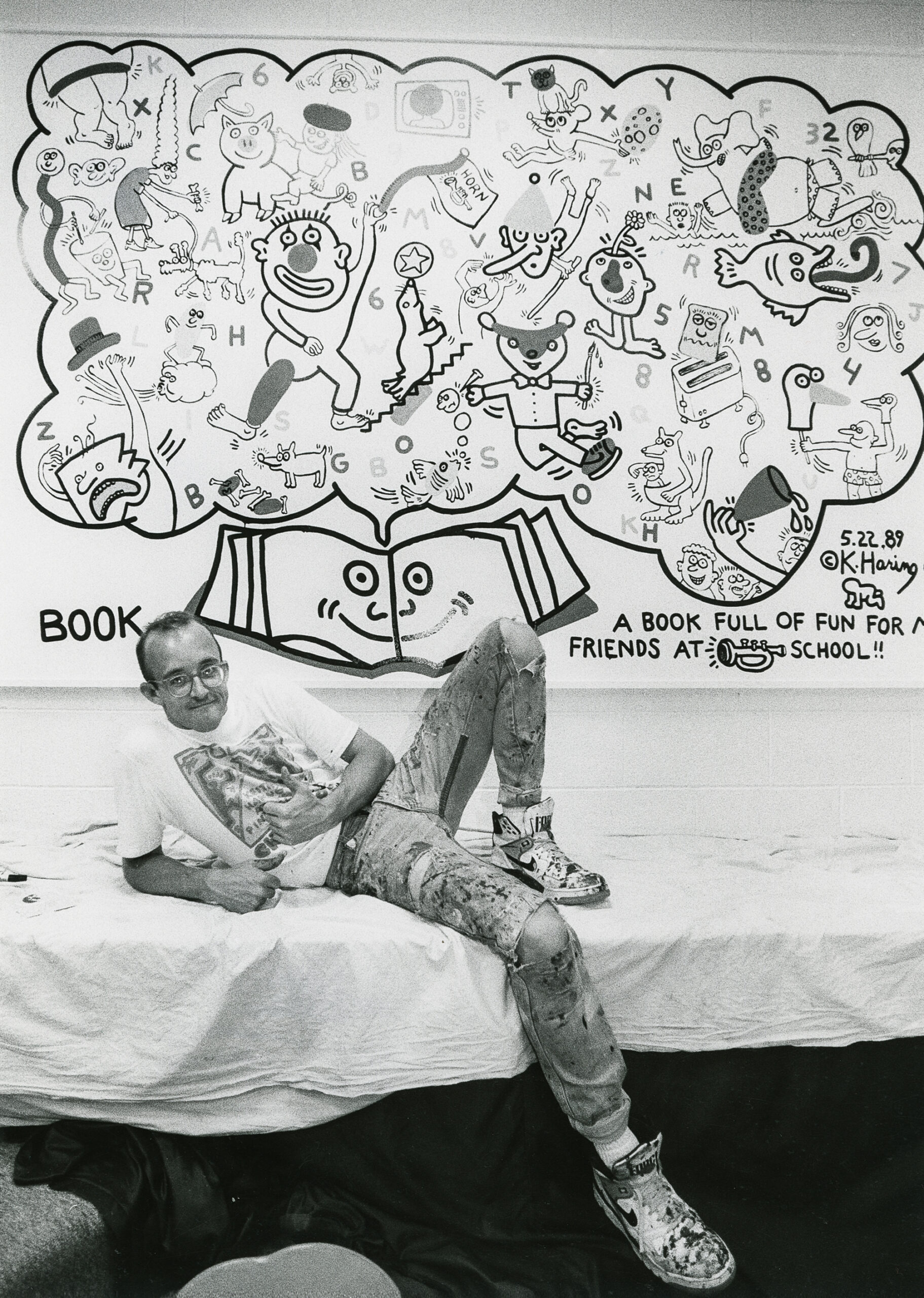
Haring’s art is known for its thick, continuous outlines, vivid colours and figures that seem to pulse with movement. Radiant babies, barking dogs, dancing figures and crawling shapes recur throughout his work. The symbols are simple at first glance, but often carry complex meanings. They can suggest joy and connection, while also pointing to violence, injustice and the pressures of modern life.
Although Haring became part of the international art world, he believed art should be accessible to a wide audience. In 1986, he opened the Pop Shop in New York, selling products featuring his designs at affordable prices. The shop challenged the idea that art belonged only in museums or private collections, though his approach also prompted debate about the relationship between art and commerce.
Public art and activism
Haring created murals around the world, often working with local communities. One of his best-known public works is Crack Is Wack, a mural painted in New York in 1986 to draw attention to the dangers of crack cocaine. Its direct imagery and prominent location show how he used public art to engage with urgent social issues.
He also supported children’s organisations and LGBTQ+ rights, and used his art to speak out about racism, apartheid and the AIDS crisis. After learning that he had AIDS, Haring became an outspoken advocate for awareness and education. In 1989, he established the Keith Haring Foundation to support organisations working with children and people affected by HIV and AIDS, as well as arts education.
A lasting legacy
Keith Haring died in New York in 1990, aged 31. His career was brief, but his influence remains visible in contemporary art, design and popular culture. His work continues to be exhibited internationally, while the foundation he established carries on his commitment to supporting young people and making art more accessible.
Haring’s legacy lies not only in his memorable images, but also in his belief that art could belong to everyone. By bringing his work into streets, stations and community spaces, he made visual art part of everyday life—and showed that a simple line could carry a powerful message.
Keith Haring: 7 Tips for Exploring His Art
- Keith Haring was an American artist known for bold, lively images.
- Look for thick black outlines and simple, moving figures.
- His subway drawings helped bring his art into public spaces.
- The radiant baby is one of his best-known symbols.
- His work often explored love, peace and social justice.
- Notice how his figures seem to dance or move across the page.
- Explore his murals and posters as well as his gallery art.
Keith Haring was an American artist known for bold, lively images.
Keith Haring was an American artist celebrated for his bold, lively images, created with strong outlines, bright colours and figures full of movement. His distinctive visual style made his work instantly recognisable and helped bring art into public spaces, from New York’s subway stations to large-scale murals.
Look for thick black outlines and simple, moving figures.
Look for Keith Haring’s thick black outlines and simple, energetic figures. Often shown dancing, running or reaching out, they seem to move across the page, giving his work its distinctive sense of rhythm and life.
His subway drawings helped bring his art into public spaces.
Keith Haring’s subway drawings brought his art into the heart of everyday life. In the early 1980s, he used chalk to create quick, energetic images on the black paper covering unused advertising panels in New York City stations. Commuters encountered his bold figures and symbols as part of their daily journeys, making the subway a public gallery and helping Haring connect with people beyond the traditional art world.
The radiant baby is one of his best-known symbols.
Keith Haring’s Radiant Baby is one of his best-known symbols: a crawling infant surrounded by short lines that suggest energy, light and movement. The image can be read as a sign of hope, innocence and new life, while also reflecting Haring’s interest in the creative power and potential of every person. Simple yet full of vitality, the Radiant Baby became a defining emblem of his bold visual language.
His work often explored love, peace and social justice.
Keith Haring’s work often explored love, peace and social justice. Through bold lines, vivid colours and lively figures, he created art that spoke to people from all walks of life. His images could celebrate connection and compassion while also drawing attention to issues such as inequality, racism and the AIDS crisis, reflecting his belief that art could inspire understanding and positive change.
Notice how his figures seem to dance or move across the page.
Notice how Keith Haring’s figures seem to dance and move across the page. With bold outlines, repeated shapes and radiating lines, he gives each figure a sense of rhythm and energy, as though it is caught in the middle of a lively performance. This movement draws the eye through the artwork and makes even simple forms feel full of life.
Explore his murals and posters as well as his gallery art.
Explore Keith Haring’s murals and posters as well as his gallery art to see how he brought his bold, energetic style into everyday spaces. From public walls and subway stations to works shown in galleries, his art combines playful figures and vivid colours with messages about community, social justice and human rights. Comparing these different forms reveals how Haring made art accessible to a wide audience.