Joan Miró: A Life in Colour and Imagination
Joan Miró (1893–1983) was a Catalan artist whose paintings, sculptures and public artworks helped reshape modern art. Known for vivid colours, playful forms and a personal language of signs, he created work that seems at once spontaneous and carefully considered. Although often associated with Surrealism, Miró developed an artistic vision that remained distinctly his own.
Early life and artistic beginnings
Miró was born in Barcelona on 20 April 1893. He studied at the Escola d’Arts i Oficis de la Llotja and later attended an art academy run by Francesc Galí. After working in business for a short time, he chose to devote himself to art.
His early paintings drew on the landscapes and rural life of Catalonia. The Farm (1921–22), for example, portrays his family’s farm at Mont-roig with close attention to its people, animals and objects. The work also points towards the distinctive visual language he would develop: familiar things are arranged with precision, yet carry a sense of mystery.
Finding a new visual language
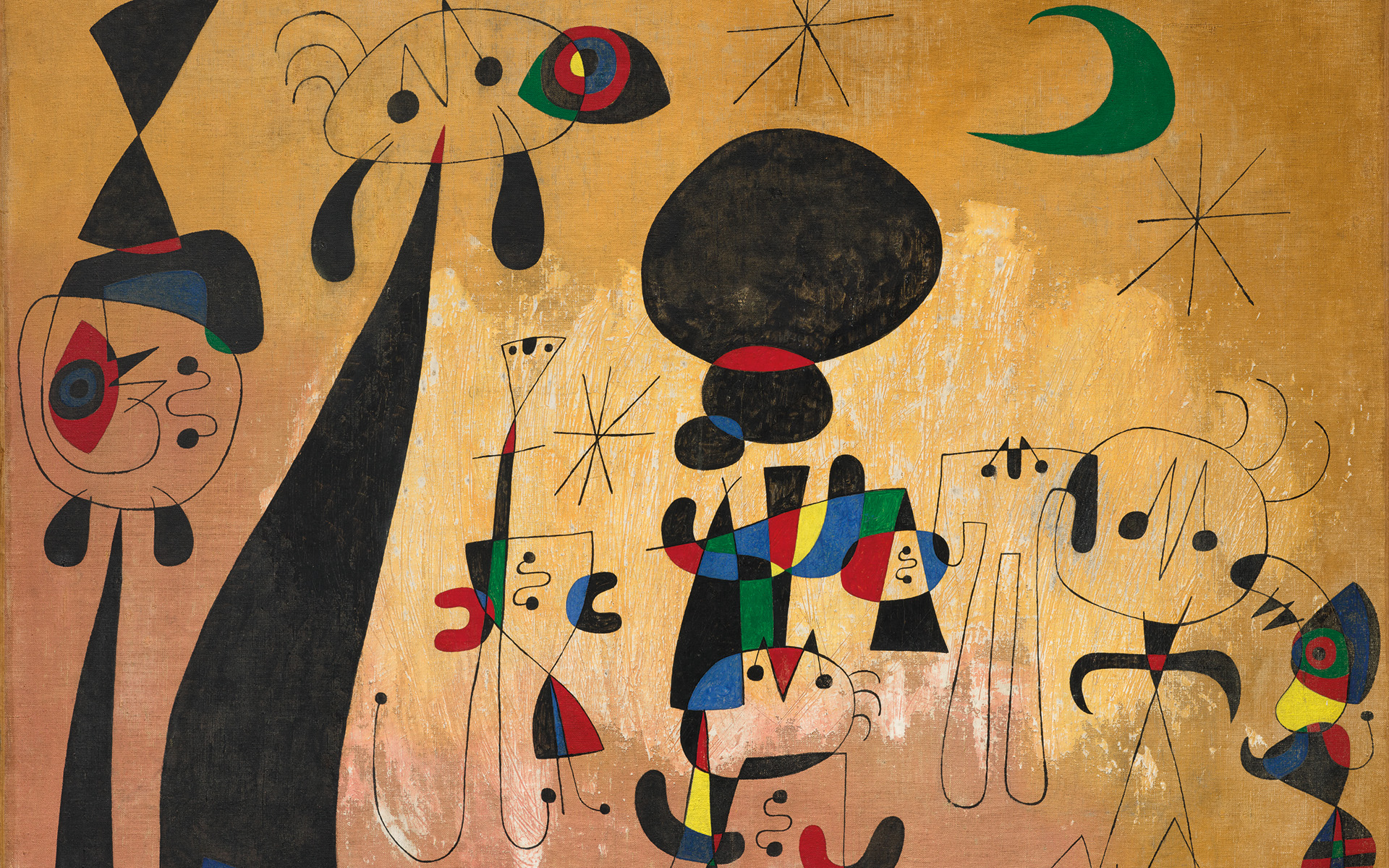
In the 1920s, Miró spent time in Paris, where he encountered writers and artists who were exploring dreams, the unconscious and new approaches to representation. He became connected with the Surrealists, but did not simply follow their methods. Instead, he created a vocabulary of floating shapes, lines, stars, eyes and other signs that could suggest figures or landscapes without describing them realistically.
Works such as The Tilled Field (1923–24) and The Harlequin’s Carnival (1924–25) show this growing freedom. Their dreamlike scenes combine recognisable details with invented forms, inviting viewers to make their own connections.
War and a changing world
The political upheaval of the 1930s affected Miró’s work. During the Spanish Civil War, he made art in support of the Spanish Republic, including the poster Aidez l’Espagne (Help Spain, 1937). For the Spanish pavilion at the 1937 Paris International Exhibition, he also created a large mural, The Reaper. The mural was dismantled after the exhibition and is now considered lost.
In 1940, as Europe was engulfed by war, Miró began his Constellations series. These small, intricate works bring together stars, birds, figures and abstract marks. Their lively compositions offer a striking contrast to the conflict and uncertainty of the period.
Beyond painting
Miró’s creativity extended well beyond the canvas. He worked in sculpture, ceramics, printmaking and textiles, often collaborating with skilled craftspeople. These different materials allowed him to explore how shapes, colours and symbols could occupy real space as well as painted surfaces.
He also created major works for public settings, including murals and sculptures. His monumental sculpture Woman and Bird (1982), in Barcelona, is among his best-known public works. Its bold form and colourful surface reflect the energy and simplicity that characterise much of his later art.
Legacy
Miró spent much of his later life in Mallorca, where he continued to work until his death in 1983. The Fundació Joan Miró opened in Barcelona in 1975, giving the public a place to encounter his work and learn about his artistic practice.
Today, Miró is celebrated for making modern art feel open to curiosity and interpretation. His work does not offer a single fixed meaning; instead, it invites viewers to look closely, follow its visual rhythms and imagine what its shapes and symbols might suggest. That balance of freedom, precision and play continues to make his art distinctive.
Joan Miró: Seven Reasons to Celebrate His Art
- A pioneering Catalan artist
- Known for vivid colours
- Created a distinctive visual language
- Helped shape modern art
- Worked across painting, sculpture and ceramics
- Inspired curiosity and imagination
- His art is celebrated worldwide
6 Criticisms of Joan Miró’s Art
- Some works can feel too abstract for casual viewers.
- His visual symbols can be difficult to interpret.
- The playful style may seem overly childlike to some.
- His recurring motifs can make some works feel similar.
- His art may prioritise mood over clear storytelling.
- Some viewers may find his later work too simplified.
A pioneering Catalan artist
Joan Miró was a pioneering Catalan artist whose bold experiments helped transform modern art. Drawing on the landscapes and culture of Catalonia, he developed a distinctive visual language of vivid colour, playful shapes and symbolic forms. His work crossed boundaries between painting, sculpture, ceramics and printmaking, inspiring artists to approach art with greater freedom and imagination.
Known for vivid colours
Joan Miró is renowned for his vivid use of colour, bringing energy and movement to his paintings, sculptures and prints. Bright reds, blues, yellows and greens often appear alongside bold black lines and playful shapes, creating striking compositions that feel both lively and dreamlike. His colour choices were more than decorative: they helped express emotion, guide the viewer’s eye and give his distinctive visual language its lasting appeal.
Created a distinctive visual language
Joan Miró created a distinctive visual language of bold colours, flowing lines and dreamlike symbols. Stars, birds, eyes and abstract figures recur throughout his work, suggesting people and places without depicting them realistically. This imaginative approach gave his art a recognisable style while inviting viewers to interpret each image in their own way.
Helped shape modern art
Joan Miró helped shape modern art by developing a distinctive visual language that moved beyond realistic representation. Combining bold colours, abstract shapes and dreamlike symbols, he created works that encouraged viewers to interpret images in new ways. His experiments across painting, sculpture, ceramics and printmaking influenced generations of artists and helped broaden the possibilities of modern art.
Worked across painting, sculpture and ceramics
Joan Miró worked across painting, sculpture and ceramics, allowing his distinctive visual language to take shape in many different forms. He carried his bold colours, playful symbols and abstract shapes beyond the canvas, exploring how they could interact with texture, scale and three-dimensional space. This versatility helped make his work feel inventive and connected, while showing that his artistic ideas were not confined to a single medium.
Inspired curiosity and imagination
Joan Miró’s art inspires curiosity and imagination through its vivid colours, playful shapes and mysterious symbols. Rather than depicting the world realistically, his paintings invite viewers to explore each detail and decide what the forms might represent. This open-ended approach makes his work engaging for people of all ages, encouraging them to look closely, ask questions and imagine their own stories.
His art is celebrated worldwide
Joan Miró’s art is celebrated worldwide for its vivid colours, imaginative symbols and distinctive sense of movement. His paintings, sculptures and public artworks have been exhibited in leading museums and galleries, inspiring generations of artists and audiences. By blending playful forms with thoughtful ideas, Miró created a visual language that continues to resonate across cultures.
Some works can feel too abstract for casual viewers.
One possible drawback of Joan Miró’s work is that its abstract forms and personal symbols can feel difficult to interpret, particularly for casual viewers looking for a clear subject or story. The playful shapes and vivid colours may be immediately appealing, but without context, some works can seem puzzling or disconnected. This ambiguity is also central to Miró’s artistic style, inviting viewers to form their own interpretations rather than offering a single, obvious meaning.
His visual symbols can be difficult to interpret.
One challenge in Joan Miró’s work is that his visual symbols can be difficult to interpret. Floating shapes, stars, eyes and lines may suggest people, nature or dreams, but they rarely have one clear meaning. This ambiguity can make his art feel intriguing and open-ended, though some viewers may find it hard to understand what a particular work is expressing.
The playful style may seem overly childlike to some.
One criticism of Joan Miró’s work is that its playful style can seem overly childlike to some viewers. His bold colours, simplified shapes and whimsical symbols may appear less serious or technically demanding than more realistic art. However, this apparent simplicity often reflects a deliberate and carefully developed visual language, rather than a lack of skill or depth.
His recurring motifs can make some works feel similar.
One possible drawback of Joan Miró’s work is that his recurring motifs—such as stars, birds, eyes and simplified figures—can make some pieces feel similar at first glance. While these symbols form a distinctive visual language, viewers may find that certain works offer less variety than others. Looking more closely, however, often reveals differences in composition, colour and mood.
His art may prioritise mood over clear storytelling.
One possible drawback of Joan Miró’s art is that it can prioritise mood and visual rhythm over clear storytelling. His abstract symbols and dreamlike forms often resist a single, easy interpretation, which may leave viewers unsure what a work is meant to convey. While this openness is central to its appeal, those who prefer recognisable scenes or a clear narrative may find his art difficult to connect with.
Some viewers may find his later work too simplified.
Some viewers may find Joan Miró’s later work too simplified, particularly its bold colours, sparse compositions and reduced forms. Where his earlier paintings often contain intricate detail, the later pieces can seem less complex or less carefully developed at first glance. However, this pared-back style reflects Miró’s interest in expressing ideas with the fewest possible elements, leaving space for viewers to interpret the shapes and symbols for themselves.