Jackson Pollock: The Artist Who Changed the Canvas
Jackson Pollock was one of the most influential American artists of the 20th century. Best known for his energetic “drip” paintings, he helped redefine what a painting could be. Rather than treating the canvas as a window onto a scene, Pollock made it a surface for movement, gesture and chance.
Early life and artistic beginnings
Paul Jackson Pollock was born in Cody, Wyoming, in 1912 and grew up in the western United States. As a young man, he moved to New York to study art, where he encountered the work of modern European artists and became part of a lively artistic community. His early paintings drew on a range of influences, including Mexican muralists and Native American art, as well as the psychological ideas and mythic imagery that interested many artists of his generation.
Pollock’s career developed during a period when New York was becoming an important centre for modern art. He was associated with Abstract Expressionism, a movement in which artists used abstraction to convey ideas, emotion and personal experience. His wife, the painter Lee Krasner, was also an accomplished artist and an important part of his creative and professional life.
The drip paintings
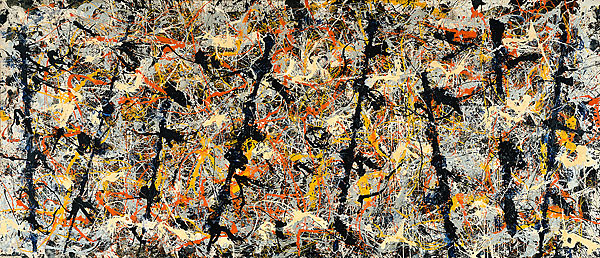
Pollock’s most distinctive works emerged in the late 1940s. He placed large canvases on the floor and moved around them, pouring, dripping or flinging paint across their surfaces. He sometimes used sticks, hardened brushes and other tools rather than conventional brushes. The resulting lines and splashes overlap in intricate patterns, with no single focal point directing the viewer’s attention.
This approach is often called “action painting” because the physical act of making the work is so visible. Pollock’s process involved deliberate choices, but also allowed for unpredictability: the flow of paint, the movement of his body and the layers already on the canvas all shaped the final composition. Works such as Number 1A, 1948 and Autumn Rhythm (Number 30) show the scale and complexity of this technique.
Recognition and controversy
Pollock’s paintings attracted both acclaim and criticism. Some viewers saw them as a radical new language; others questioned whether they were art at all. In 1949, a profile in Life magazine asked whether he was the greatest living painter in the United States, bringing his work to a much wider public. The attention made Pollock a prominent, and at times controversial, figure in American culture.
His career was cut short when he died in a car crash in 1956, aged 44. In the years since, his paintings have continued to be exhibited and studied around the world.
A lasting influence
Pollock’s importance lies not only in the appearance of his paintings, but also in the questions they raised about artistic practice. He challenged expectations about composition, technique and the role of the artist, encouraging later generations to think differently about materials and process. His work remains open to interpretation: viewers may find rhythm, tension, movement or simply the trace of an artist’s actions across a vast surface.
More than six decades after his death, Jackson Pollock remains a defining figure in modern art. His paintings capture a moment when artists were seeking new ways to express experience—and when the act of painting itself became part of the subject.
Jackson Pollock: Five Frequently Asked Questions
- Who was Jackson Pollock?
- What is Jackson Pollock famous for?
- How did Jackson Pollock create his drip paintings?
- What are Jackson Pollock’s most famous paintings?
- When and how did Jackson Pollock die?
Who was Jackson Pollock?
Jackson Pollock (1912–1956) was an influential American painter and a leading figure in Abstract Expressionism. He is best known for his large “drip paintings”, made by pouring, dripping and splashing paint across canvases laid on the floor. His energetic technique made the process of painting part of the artwork and helped reshape modern art.
What is Jackson Pollock famous for?
Jackson Pollock is famous for his energetic drip paintings, in which he poured, dripped and flicked paint across large canvases laid on the floor. A leading figure in Abstract Expressionism, he made the process of painting part of the artwork, creating intricate compositions that transformed ideas about art and artistic technique.
How did Jackson Pollock create his drip paintings?
Jackson Pollock created his drip paintings by laying large canvases on the floor and moving around them as he poured, dripped or flicked paint across the surface. He often used sticks, trowels and hardened brushes rather than applying paint with a conventional brush. Working in layers, Pollock combined controlled gestures with the unpredictable flow of the paint, making the act of painting part of the finished work.
What are Jackson Pollock’s most famous paintings?
Jackson Pollock’s most famous paintings include No. 5, 1948, known for its dense web of brown, yellow and black paint; Autumn Rhythm (Number 30) (1950), a large, flowing composition of black, white and earthy colours; and Blue Poles (1952), notable for its vivid blue lines crossing a richly layered surface. Other celebrated works include Number 1A, 1948 and Convergence (1952). Together, these paintings showcase Pollock’s distinctive drip technique and his influential approach to abstraction.
When and how did Jackson Pollock die?
Jackson Pollock died on 11 August 1956, aged 44, in a car crash near his home in Springs, New York. He was driving under the influence of alcohol when his car left the road and overturned. Pollock died at the scene; his passenger, Edith Metzger, was also killed, while another passenger, artist Ruth Kligman, survived.