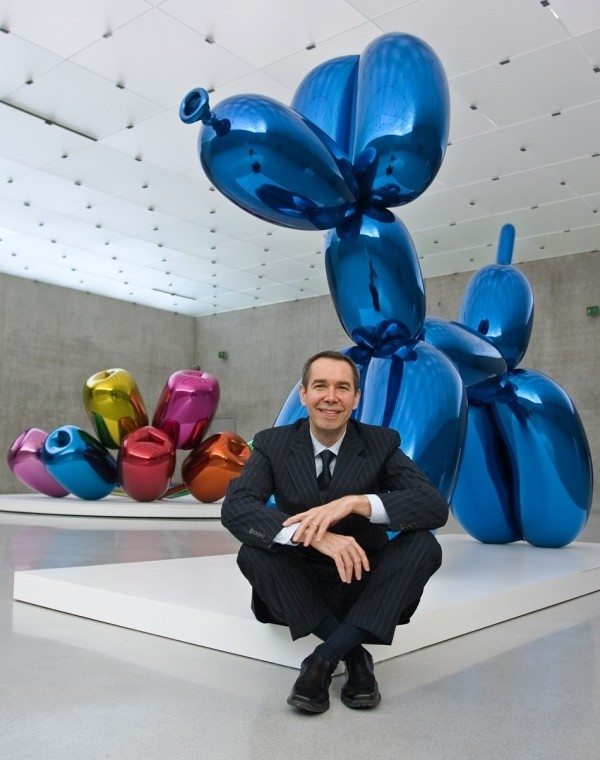
Jeff Koons: Art, Pop Culture and the Power of the Everyday
Jeff Koons is one of the most recognisable—and debated—artists of his generation. Known for gleaming sculptures, vivid colours and familiar subjects, he has spent decades exploring the boundaries between fine art, popular culture and consumer life. His work can be playful and inviting, yet it also raises questions about taste, value and what art can be.
From Pennsylvania to the art world
Koons was born in York, Pennsylvania, in 1955. He studied at the Maryland Institute College of Art and the School of the Art Institute of Chicago before moving to New York in the late 1970s. Early in his career, he worked in a range of jobs, including as a commodities broker, while developing an artistic practice shaped by the sights and objects of everyday life.
From the outset, Koons challenged the idea that art should be separate from popular culture. He drew on advertisements, household objects, toys and celebrity imagery, presenting familiar things in settings usually reserved for fine art. Rather than hiding their commercial origins, his works often bring those associations to the forefront.
Familiar objects, transformed
Koons’s best-known works include the Balloon Dog sculptures, whose reflective surfaces and inflated forms recall party balloons, and Rabbit, a stainless-steel sculpture based on an inflatable toy. Both turn light, ordinary objects into carefully made, monumental artworks. Their polished surfaces invite viewers to look—and sometimes to see themselves—in the work.
Other projects show a different side of his approach. Puppy, a large-scale sculpture of a dog covered in flowering plants, combines a monumental form with an accessible, cheerful subject. Michael Jackson and Bubbles, meanwhile, brings celebrity and popular imagery into the gallery. Across these works, Koons repeatedly uses recognisable subjects to examine how images and objects acquire meaning.
Craft, scale and spectacle
Although some of Koons’s art appears simple at first glance, its production can be technically complex. His sculptures are made using precise processes and highly finished materials, including stainless steel, porcelain and glass. He has worked with teams of specialists to realise works on a scale and with a surface quality that would be difficult to achieve by hand alone.
This emphasis on finish is central to the experience of the work. The immaculate surfaces can suggest luxury and perfection, while the subjects themselves may be inexpensive toys or mass-produced objects. The contrast encourages viewers to consider how presentation affects the way something is valued.
Popularity and debate
Koons has attracted both widespread attention and strong criticism. Supporters see his work as a compelling reflection of consumer society and a challenge to traditional distinctions between “high” and “low” culture. Critics have questioned its commercial associations, its reliance on spectacle and the extent to which its ideas are communicated through familiar imagery.
His works have also become prominent in the international art market, where they have achieved exceptionally high prices. That success adds another layer to the discussion: Koons’s art examines the relationship between objects and value while also occupying the world of luxury collecting. For some, this tension is part of the work’s significance; for others, it is a source of unease.
A lasting place in contemporary art
Jeff Koons’s art is designed to be seen, remembered and discussed. By transforming balloons, toys and familiar images into monumental sculptures, he brings everyday culture into the gallery and asks viewers to reconsider what deserves attention. Whether admired for its technical ambition or challenged for its association with commerce and spectacle, his work remains an influential—and unmistakable—presence in contemporary art.
Jeff Koons: Six Things to Know About His Art
- Jeff Koons is an American contemporary artist.
- He is known for large, shiny sculptures.
- His Balloon Dog series resembles twisted balloons.
- Koons often draws on popular culture and everyday objects.
- His work uses materials such as stainless steel and porcelain.
- Look closely at how his sculptures reflect their surroundings.
Jeff Koons is an American contemporary artist.
Jeff Koons is an American contemporary artist known for transforming familiar objects and images into bold, polished works of art. Drawing on popular culture and everyday life, his sculptures often explore ideas of taste, consumerism and the value society places on objects. His work has attracted international attention and continues to spark debate among art lovers and critics alike.
He is known for large, shiny sculptures.
Jeff Koons is known for his large, shiny sculptures, which often transform familiar objects—such as balloons and toys—into striking works of art. Made with highly polished materials, their reflective surfaces catch the light and mirror the people and spaces around them, inviting viewers to look more closely at everyday objects and how they are presented.
His Balloon Dog series resembles twisted balloons.
Jeff Koons’s Balloon Dog series transforms the familiar shape of a twisted balloon into monumental sculptures with highly polished, reflective surfaces. Though they appear playful and light, the works are made from durable materials such as stainless steel, creating a striking contrast between their toy-like form and solid construction. Their bright, celebratory look invites viewers to consider how everyday objects can become icons of contemporary art.
Koons often draws on popular culture and everyday objects.
Jeff Koons often draws inspiration from popular culture and everyday objects, transforming familiar toys, household items and images into striking works of art. By presenting these recognisable subjects on a larger scale and in polished materials, he encourages viewers to reconsider their ideas about art, taste and the value of ordinary things.
His work uses materials such as stainless steel and porcelain.
Jeff Koons uses materials such as stainless steel and porcelain to transform familiar subjects into highly polished works of art. Stainless steel can give his sculptures a mirror-like finish, reflecting their surroundings and the viewer, while porcelain offers a smooth, refined surface. The contrast between these luxurious materials and everyday or popular-culture imagery is a distinctive feature of his work.
Look closely at how his sculptures reflect their surroundings.
Take a moment to notice how Jeff Koons’s polished sculptures reflect the space around them. Their gleaming surfaces may capture nearby viewers, shifting lights and architectural details, making the surroundings part of the experience. As you move, the reflections change, offering a fresh perspective on both the artwork and the place in which it is displayed.