Jean-Michel Basquiat: Art, Identity and the City
Jean-Michel Basquiat was an American artist whose urgent, distinctive work reshaped the art world of the late 20th century. Born in Brooklyn, New York, in 1960, he combined painting, drawing and text to explore subjects including race, history, power, identity and the lives of Black people in America. He died in 1988, aged 27, but his art continues to influence artists and audiences around the world.
From SAMO to the gallery
Basquiat first attracted attention in the late 1970s through SAMO, a name used for a series of cryptic phrases and statements written on walls around Manhattan. The project was created with his friend Al Diaz. Its witty, often critical messages offered a glimpse of the ideas that would later run through Basquiat’s paintings.
As the downtown New York art scene grew around music, performance and street culture, Basquiat began exhibiting his work in galleries. His first solo exhibition took place in 1982. He soon became one of the most prominent young artists of his generation, while continuing to develop a visual language that resisted easy categorisation.
A bold and layered visual language
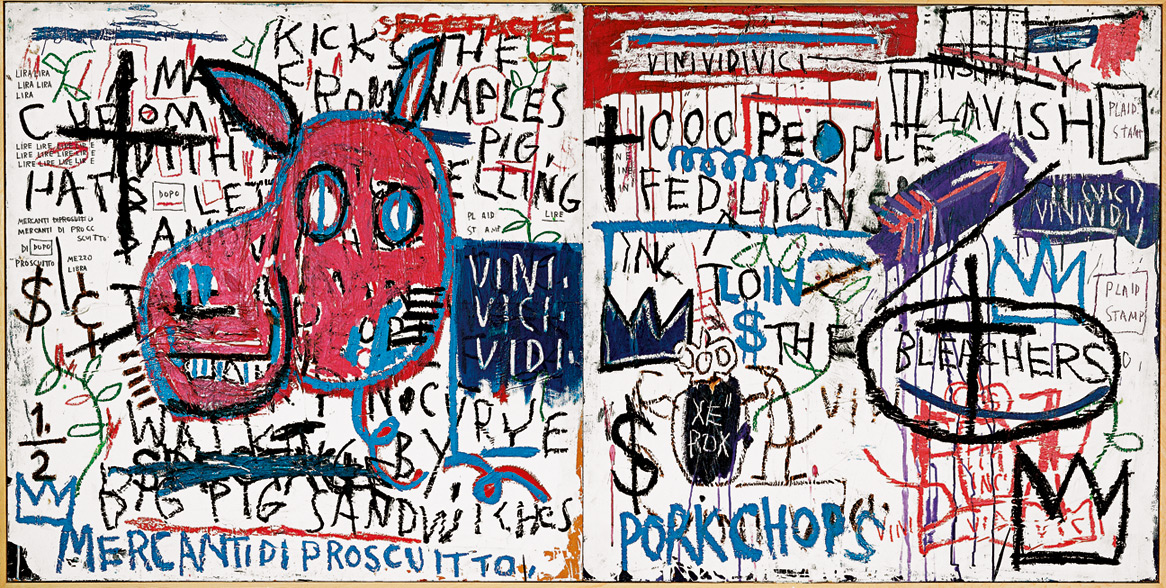
Basquiat’s paintings are known for their energetic marks, vivid colours, repeated words and striking symbols. He often worked across the surface of a canvas, allowing images and text to overlap. Crowns, skeletons, masks and fragmented figures appear alongside references to anatomy, jazz, sport, literature and history.
Rather than treating text as a caption, Basquiat made words an integral part of the image. He crossed out, repeated and rearranged phrases, drawing attention to the power of language and to the way histories are recorded. The result can feel immediate and spontaneous, but his work also reflects wide-ranging research and careful thought.
History, race and power
Basquiat’s work frequently challenges the absence or distortion of Black people in official histories and popular culture. He brought Black historical figures, musicians, athletes and everyday people into view, while confronting racism, colonialism and social inequality. His paintings can celebrate achievement and creativity while also exposing the systems that limit recognition and opportunity.
These themes were personal as well as political. Basquiat was the son of a Haitian father and a Puerto Rican mother, and his work draws on the many cultural influences around him. It does not offer simple answers: instead, it places conflicting ideas side by side and asks viewers to look more closely.
Legacy
Jean-Michel Basquiat’s career was brief, but his influence has proved enduring. His work is held in major public and private collections, and continues to be shown internationally. It has also become part of wider conversations about representation, cultural value and the relationship between street art and the institutions of the art world.
Basquiat’s paintings remain compelling because they are both visually powerful and intellectually open. They reward close attention, revealing new connections between image, language and history. More than a symbol of a particular era, Basquiat remains an artist whose work continues to ask difficult and necessary questions.
Five Tips for Understanding Basquiat’s Art
- Look for crowns, skulls and bold symbols in Basquiat’s work.
- Notice how he layers words, images and paint.
- Explore how his art responds to race, power and identity.
- Remember he began as a New York street artist known as SAMO.
- See how jazz, history and popular culture shaped his art.
Look for crowns, skulls and bold symbols in Basquiat’s work.
When looking at Jean-Michel Basquiat’s work, keep an eye out for crowns, skulls and other bold symbols. Crowns often suggest recognition, power or achievement, while skulls can bring ideas of mortality and the human body to mind. These images are layered with words, colours and energetic marks, so their meanings may shift from one painting to another. Rather than looking for a single answer, notice how the symbols interact and what they make you think or feel.
Notice how he layers words, images and paint.
Notice how Basquiat layers words, images and paint to create a sense of movement and urgency. Text may overlap with figures, symbols and bold brushstrokes, inviting you to look closely and consider how each element changes the meaning of the others. Don’t worry about finding one definitive interpretation; let the layers guide your own reading of the work.
Explore how his art responds to race, power and identity.
Explore how Jean-Michel Basquiat’s art responds to race, power and identity by looking closely at the people, symbols and words in his paintings. His work challenges the way Black history is represented, celebrates influential Black figures and draws attention to racism and unequal power. Rather than offering simple answers, Basquiat layers images and ideas to invite viewers to question who gets to shape history—and whose stories are heard.
Remember he began as a New York street artist known as SAMO.
Before becoming an internationally recognised artist, Jean-Michel Basquiat first made his mark on New York’s streets under the name SAMO. Alongside his friend Al Diaz, he painted cryptic, thought-provoking phrases on walls across Manhattan, offering sharp observations on society, politics and culture. This early street-art project introduced the bold ideas and distinctive voice that would later shape his paintings.
See how jazz, history and popular culture shaped his art.
Explore how jazz, history and popular culture shaped Jean-Michel Basquiat’s art. The rhythms and improvisation of jazz echo in his energetic marks and layered compositions, while references to historical figures and events challenge whose stories are remembered. Music, sport, comics and celebrity culture also appear throughout his work, bringing everyday imagery into conversation with questions of identity, race and power.