
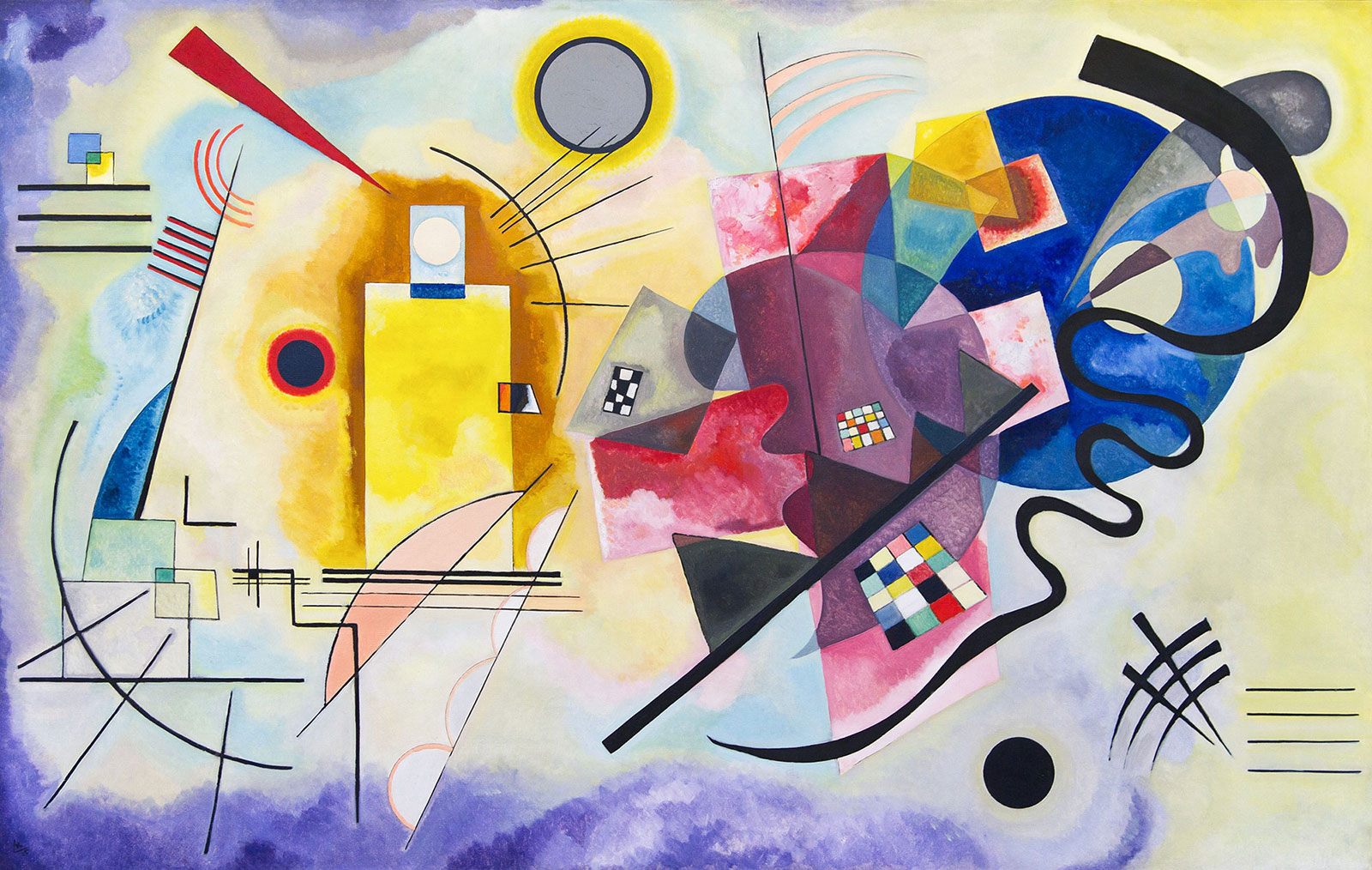
Wassily Kandinsky: A Pioneer of Abstract Art
Wassily Kandinsky (1866–1944) was a Russian-born artist and art theorist whose work helped transform modern painting. He is widely regarded as one of the pioneers of abstraction: art that does not rely on recognisable people, places or objects, but instead uses colour, line and shape to express ideas and emotions.
From Moscow to Munich
Kandinsky was born in Moscow and initially studied law and economics. In 1896, he moved to Munich to pursue art, a decision that set him on a new course. There, he trained as a painter and became part of a lively community of artists who were challenging traditional ideas about what art could be.
His early work often drew on landscapes, folklore and Russian cultural influences. Over time, however, he began to loosen the connection between painting and the visible world. Colour and form took on greater importance, allowing him to explore how a painting might communicate feeling without depicting a specific subject.
Colour, music and emotion
Music was a major inspiration for Kandinsky. He believed that colours and shapes could create emotional effects in a way comparable to musical notes and rhythms. Rather than simply representing what the eye could see, he wanted painting to speak directly to the viewer’s inner life.
These ideas are set out in his influential book Concerning the Spiritual in Art, published in 19
In it, Kandinsky argued that art could express inner experience and spiritual meaning. His approach helped establish abstraction as a serious artistic language, rather than a departure from painting’s purpose.
The Blue Rider and the path to abstraction
In Munich, Kandinsky became a leading figure in Der Blaue Reiter (The Blue Rider), an artists’ group he helped establish with Franz Marc in 19
The group brought together artists interested in new forms of expression and the spiritual dimensions of art. It was not a formal school with a single style, but its members shared a willingness to question convention.
During this period, Kandinsky produced increasingly abstract works. Paintings such as Composition VII (1913) bring together sweeping lines, vivid colour and overlapping shapes in a dynamic arrangement. The titles of his works—including Improvisations and Compositions—also reflect his interest in musical structures and spontaneous expression.
The Bauhaus years
After returning to Russia following the First World War, Kandinsky took part in the country’s cultural and artistic life. He later moved to Germany, where he taught at the Bauhaus, the influential school of art, design and architecture. From 1922 until the school closed in 1933, he taught students to consider how colour, shape and composition work together.
His art from this period often features precise geometric forms, including circles, triangles and grids. These works differ from the more fluid paintings of his earlier years, yet they continue his investigation into the expressive potential of abstract forms.
Legacy
When the Nazis forced the Bauhaus to close, Kandinsky left Germany and settled in France. He continued to paint there until his death in 19
Across several decades, his work evolved from expressive landscapes to bold, fully abstract compositions.
Kandinsky’s legacy lies not only in the paintings themselves, but also in his conviction that art could communicate beyond literal representation. His ideas influenced generations of artists and helped open the way for new approaches to painting. Today, his work remains an invitation to look closely, respond to colour and shape, and find meaning beyond what is immediately recognisable.
Eight Reasons to Celebrate Wassily Kandinsky’s Artistic Legacy
- Pioneered abstract art.
- Used colour to express emotion.
- Found inspiration in music.
- Helped establish The Blue Rider.
- Created vivid, dynamic compositions.
- Explored geometric forms at the Bauhaus.
- Wrote influential art theory.
- Inspired generations of artists.
Seven Drawbacks of Kandinsky’s Art and Legacy
- Some works can feel difficult to interpret.
- Abstract forms may not appeal to everyone.
- His art can seem overly theoretical.
- Later geometric works may feel rigid.
- The lack of clear subjects can feel distancing.
- His writing can be challenging to read.
- His fame can overshadow other abstract artists.
Pioneered abstract art.
Wassily Kandinsky is widely regarded as one of the pioneers of abstract art. He moved beyond painting recognisable subjects, using colour, line and shape to express emotion and ideas in their own right. His innovative work helped establish abstraction as a powerful new direction in modern art and inspired generations of artists.
Used colour to express emotion.
Kandinsky used colour to express emotion rather than simply describe what he saw. He believed that colours could affect the viewer in much the same way as musical notes, with different hues and combinations creating distinct moods and sensations. By pairing vivid colours with dynamic lines and shapes, he gave his abstract paintings a powerful emotional quality.
Found inspiration in music.
Kandinsky found lasting inspiration in music, believing that colour and shape could move people much like melody and rhythm. He often described his paintings in musical terms, giving works titles such as Improvisations and Compositions. This connection encouraged him to move beyond depicting recognisable subjects and use colour, line and form to express emotion directly.
Helped establish The Blue Rider.
Wassily Kandinsky helped establish The Blue Rider (Der Blaue Reiter) in Munich in 1911, alongside fellow artist Franz Marc. The group brought together artists who sought new ways to express spiritual ideas and inner experience through colour, form and subject matter. Though short-lived, The Blue Rider became an influential force in modern art and helped advance the development of abstraction.
Created vivid, dynamic compositions.
Kandinsky created vivid, dynamic compositions that draw the eye through bold colours, sweeping lines and energetic shapes. Rather than simply depicting the world around him, he used these elements to suggest movement, emotion and rhythm, giving his abstract paintings a powerful sense of life.
Explored geometric forms at the Bauhaus.
At the Bauhaus, Kandinsky explored how geometric forms such as circles, triangles and lines could work together to create balance, movement and emotional impact. His teaching encouraged students to consider the relationships between shape and colour, while his paintings from this period developed a more structured, geometric style. This exploration became an important part of his artistic career and helped expand the possibilities of abstract art.
Wrote influential art theory.
Kandinsky was also an influential art theorist whose writing helped explain the ideas behind modern and abstract art. In Concerning the Spiritual in Art, he explored how colour and form could express emotion and inner experience, while Point and Line to Plane examined the visual impact of basic elements in a composition. His theories encouraged artists and viewers to think of painting as more than a representation of the visible world.
Inspired generations of artists.
Kandinsky’s bold experiments with colour, shape and abstraction inspired generations of artists to look beyond realistic representation. Through both his paintings and his writing, he showed how art could express emotion and ideas without depicting recognisable subjects. His work helped open new possibilities for modern art, influencing artists who continued to explore abstraction in their own ways.
Some works can feel difficult to interpret.
One possible drawback of Kandinsky’s work is that it can be difficult to interpret. Because many of his paintings use abstract shapes, colours and lines rather than recognisable subjects, viewers may be unsure what they are meant to convey. This openness can encourage personal responses, but it may also make some works feel inaccessible without knowledge of Kandinsky’s ideas and artistic context.
Abstract forms may not appeal to everyone.
Kandinsky’s abstract forms can be challenging for viewers who prefer art with recognisable subjects or clear narratives. Without familiar figures or scenes to guide interpretation, his use of colour, shape and line may feel distant or difficult to connect with, so his work may not appeal to everyone.
His art can seem overly theoretical.
One criticism of Kandinsky’s work is that it can seem overly theoretical, particularly when viewed alongside his writings about spirituality, colour and abstraction. For some viewers, knowing the ideas behind a painting may feel necessary to appreciate it, while the shapes and colours alone can seem difficult to connect with or emotionally distant. Others, however, find that this openness is part of the appeal, allowing each viewer to form a personal response.
Later geometric works may feel rigid.
Kandinsky’s later geometric works can feel rigid beside the energy and spontaneity of his earlier paintings. Their carefully arranged circles, triangles and lines may seem overly controlled, leaving some viewers longing for a greater sense of movement or emotional warmth.
The lack of clear subjects can feel distancing.
Kandinsky’s abstract paintings can feel distancing because they often lack clear subjects or familiar scenes to guide the viewer. Without recognisable figures or objects, it may be difficult to know where to begin or what the work is communicating. This openness can invite personal interpretation, but it may also leave some viewers feeling disconnected or unsure how to engage with the painting.
His writing can be challenging to read.
Kandinsky’s writing can be challenging to read, particularly for those unfamiliar with art theory or spiritual philosophy. His arguments often use abstract concepts and specialised language, and some of his terminology reflects the period in which he wrote. As a result, his ideas may take time to follow, even for readers interested in his art.
His fame can overshadow other abstract artists.
Kandinsky’s fame can sometimes overshadow other artists who helped shape abstract art. His pioneering work is widely celebrated, but focusing too heavily on his achievements can leave less room to recognise the diverse ideas and contributions of his contemporaries and later artists. A broader view of abstraction makes for a richer understanding of the movement and the many people who developed it.

