Marc Chagall: A World of Colour, Memory and Imagination
Marc Chagall was one of the most distinctive artists of the 20th century. His paintings, prints, stained-glass windows and large-scale commissions combine vivid colour with scenes drawn from memory, folklore, religion and everyday life. Floating figures, lovers, animals and village landscapes recur throughout his work, creating a dreamlike world that is unmistakably his own.
Early life in Vitebsk
Chagall was born Moishe Shagal on 7 July 1887 in Vitebsk, a town in the Russian Empire that is now in Belarus. He grew up in a Jewish family, and the people, customs and landscapes of his childhood remained important sources of inspiration throughout his life.
After studying art in St Petersburg, Chagall moved to Paris in 19
There, he encountered the work of modern artists and movements including Cubism and Fauvism. He absorbed elements of these styles but developed a personal approach that resisted easy classification. Rather than aiming for realistic scenes, he used expressive colour and unusual arrangements to evoke emotion, memory and fantasy.
Art shaped by love and upheaval
Chagall’s work often draws on personal experience. His relationship with Bella Rosenfeld, whom he married in 1915, inspired many tender, floating portraits of lovers. Their lives were also shaped by political upheaval. After the Russian Revolution, Chagall worked in Vitebsk and helped establish an art school there. He later returned to France, where he continued to develop his practice.
The rise of Nazism and the persecution of Jewish people forced Chagall to leave Europe for the United States in 19
His paintings from this period include The White Crucifixion (1938), a powerful response to violence against Jewish communities. Bella died in 1944, a loss that deeply affected him and his work. Chagall returned to France after the Second World War and settled in the south of the country.
A recognisable artistic language
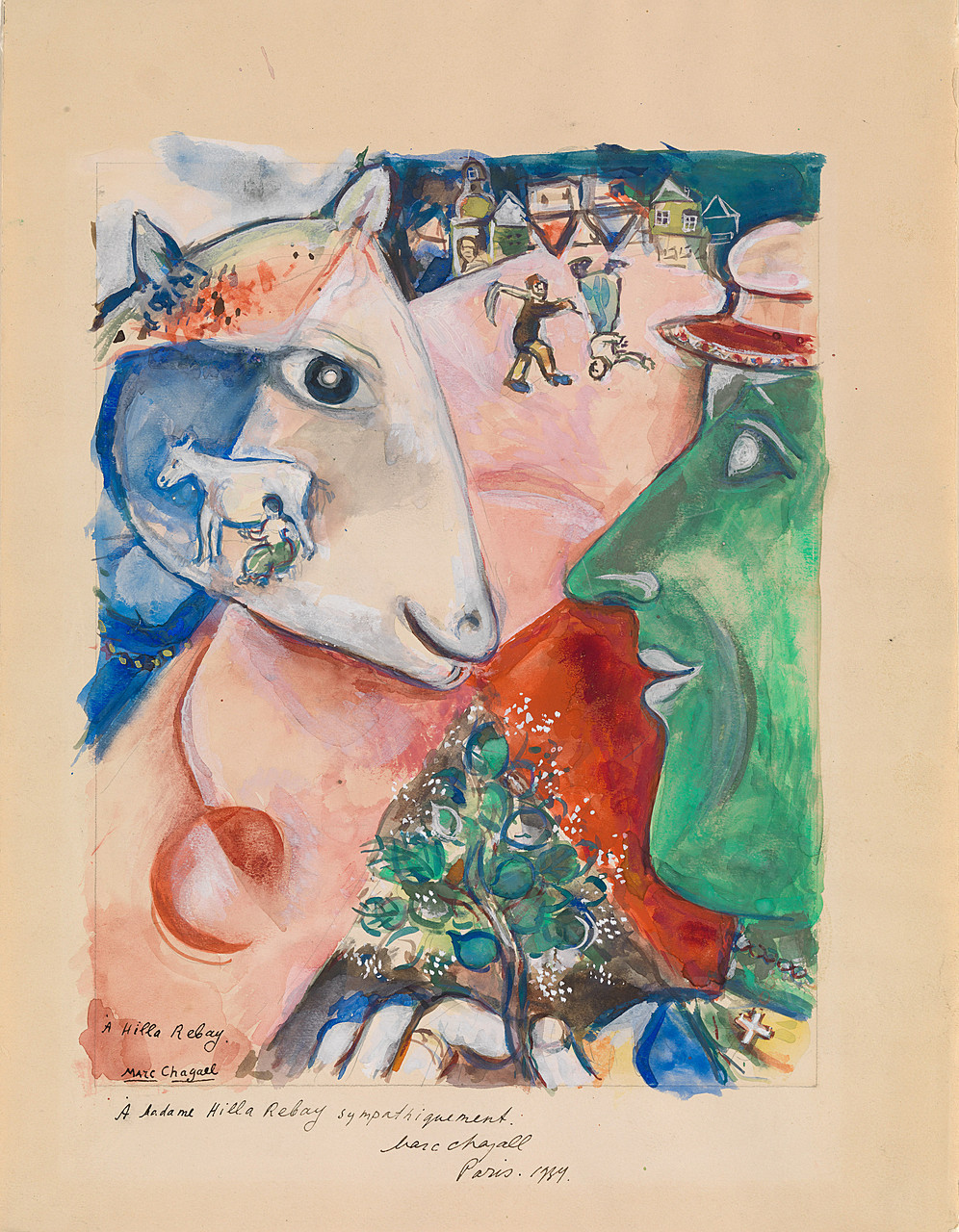
Chagall’s pictures bring together elements that might otherwise seem unrelated: a violinist, a bouquet of flowers, a village house or a figure suspended in the sky. These images are not simply decorative. They connect to his memories of home, Jewish traditions, love, loss and the wider events of his time.
His style is often described as dreamlike, but it also has a strong emotional and cultural grounding. Chagall’s use of colour is central to this effect. Deep blues, reds, greens and yellows give his scenes a sense of intensity and movement, while shifting scale and perspective allow memories and feelings to take visual form.
Beyond the canvas
Although Chagall is best known for painting, his work extended into many other fields. He created prints, book illustrations, tapestries and stage designs, as well as monumental stained-glass windows. Among his best-known public projects are the windows for the Hadassah Medical Centre in Jerusalem, completed in 1962, and the painted ceiling of the Paris Opéra, unveiled in 1964.
These commissions brought his imaginative imagery into public spaces, where it could be experienced by people beyond the gallery. The stained glass, in particular, allowed Chagall to explore how light and colour could transform architecture.
Legacy
Marc Chagall died in Saint-Paul-de-Vence, France, on 28 March 19
His long career crossed borders, artistic movements and media, yet his work remained rooted in a distinctive personal vision. Today, his art continues to attract audiences with its combination of visual invention and deeply human themes.
Chagall’s lasting achievement lies in making the private and the universal feel closely connected. His paintings turn memories into vivid images and invite viewers to see the world not only as it appears, but as it is felt and remembered.
Marc Chagall: Seven Reasons to Celebrate His Art and Legacy
- Renowned for his vivid use of colour
- Created a distinctive, dreamlike style
- Drew inspiration from Jewish culture and folklore
- Expressed love, memory and loss with sensitivity
- Worked across painting, printmaking and stained glass
- Produced celebrated public artworks
- Remains one of the 20th century’s most recognisable artists
Seven Criticisms of Marc Chagall’s Art
- His dreamlike imagery can feel difficult to interpret.
- Recurring motifs may seem repetitive.
- His symbolism is not always clearly explained.
- Some works prioritise emotion over realism.
- The vivid colours may overwhelm some viewers.
- His style can feel sentimental to some critics.
- His work may be less accessible without historical context.
Renowned for his vivid use of colour
Marc Chagall is renowned for his vivid use of colour, which gives his paintings a distinctive sense of movement, emotion and imagination. Rich blues, reds, greens and yellows bring his dreamlike scenes to life, helping convey memories, love and cultural identity while making his work instantly recognisable.
Created a distinctive, dreamlike style
Marc Chagall created a distinctive, dreamlike style that blended vivid colours, floating figures and unexpected combinations of images. Drawing on childhood memories, folklore, love and Jewish culture, he made ordinary subjects feel magical and emotionally resonant. His imaginative approach gave his work a recognisable quality and helped him stand apart from other artists of his time.
Drew inspiration from Jewish culture and folklore
Marc Chagall drew deeply on Jewish culture and folklore, bringing the traditions, stories and everyday life of his upbringing in Vitebsk into his art. Images of village life, fiddlers, rabbis and familiar animals appear in his distinctive, dreamlike scenes, often alongside symbols from Jewish religious and cultural traditions. By blending these influences with vivid colour and imaginative forms, Chagall created work that celebrated his heritage while expressing universal themes of memory, faith, love and belonging.
Expressed love, memory and loss with sensitivity
Marc Chagall expressed love, memory and loss with remarkable sensitivity, drawing on his childhood in Vitebsk and his relationships to create deeply personal yet widely relatable art. Tender images of lovers, family and familiar village life often appear alongside dreamlike colours and floating figures, giving his memories a sense of intimacy and wonder. After the death of his wife, Bella, themes of grief and longing became especially poignant in his work, allowing viewers to feel the emotional depth behind its imaginative imagery.
Worked across painting, printmaking and stained glass
Marc Chagall’s versatility allowed him to express his distinctive vision across painting, printmaking and stained glass. Each medium offered different ways to explore colour, light and storytelling: his prints brought his imagery to a wider audience, while his stained-glass works transformed public spaces with vibrant scenes that shift with the light. This breadth helped make his art both varied and instantly recognisable.
Produced celebrated public artworks
Marc Chagall created celebrated public artworks that brought his distinctive imagery to audiences beyond the gallery. His best-known projects include the stained-glass windows for the Hadassah Medical Centre in Jerusalem and the painted ceiling of the Paris Opéra. Through vibrant colour, symbolic figures and scenes inspired by memory and faith, these works transformed public spaces into expressive, welcoming environments.
Remains one of the 20th century’s most recognisable artists
Marc Chagall remains one of the 20th century’s most recognisable artists, thanks to his vivid colours, dreamlike compositions and distinctive imagery. Floating figures, lovers, musicians and scenes inspired by his Jewish heritage and childhood in Vitebsk give his work an unmistakable character. His paintings and public commissions continue to captivate audiences around the world, ensuring his lasting place in modern art.
His dreamlike imagery can feel difficult to interpret.
One criticism of Marc Chagall’s work is that its dreamlike imagery can be difficult to interpret. Floating figures, shifting perspectives and symbolic details often resist a single clear meaning, which may leave viewers unsure how to read a painting. While this ambiguity is central to the imaginative appeal of his art, it can also make the work feel obscure or inaccessible to those who prefer more direct visual storytelling.
Recurring motifs may seem repetitive.
A recurring criticism of Marc Chagall’s work is that its familiar motifs—floating figures, lovers, animals and village scenes—can begin to feel repetitive, particularly when encountered across many paintings. While these images reflect his memories and personal symbolism, their frequent return may leave some viewers wanting greater variety or development.
His symbolism is not always clearly explained.
One criticism of Marc Chagall’s work is that its symbolism is not always clearly explained. His paintings bring together figures, animals and objects drawn from personal memories, Jewish traditions and dreams, but he rarely provided a definitive key to what they mean. This openness can make the works intriguing, inviting viewers to form their own interpretations, yet it can also leave some feeling uncertain about how to understand the imagery.
Some works prioritise emotion over realism.
One criticism of Marc Chagall’s work is that it often prioritises emotion and imagination over realism. Figures may appear to float, proportions can be distorted, and scenes may feel more like dreams or memories than believable depictions of the world. This expressive approach gives his art its distinctive character, but viewers who value accurate representation may find some works difficult to connect with or less convincing.
The vivid colours may overwhelm some viewers.
The vivid colours in Marc Chagall’s work are central to its emotional impact, but their intensity may overwhelm some viewers. Bold contrasts and richly saturated tones can draw attention away from the finer details of a composition, making the paintings feel busy or visually demanding. This response is subjective, however: for many people, the exuberant colour is also one of Chagall’s greatest strengths.
His style can feel sentimental to some critics.
Some critics find Marc Chagall’s work overly sentimental, arguing that its floating lovers, vivid colours and dreamlike imagery can soften complex experiences into scenes of nostalgia or romance. For these viewers, the emotional directness that makes his art memorable can sometimes feel too sweet or idealised. Others see that same tenderness as a deliberate strength: a way of expressing love, loss and cultural memory amid the upheavals of his time.
His work may be less accessible without historical context.
Chagall’s work can be less accessible to viewers unfamiliar with the history and traditions behind its imagery. References to his Jewish upbringing, the culture of Vitebsk and the upheavals of 20th-century Europe may not be immediately clear, so some paintings can seem puzzling without further context. While the vivid colours and dreamlike scenes still have strong visual appeal, understanding their personal and historical significance can deepen the experience.