Louise Bourgeois: Art, Memory and the Human Condition
Louise Bourgeois (1911–2010) was a French-American artist whose work explored memory, family, identity, sexuality and the body. Across a career spanning more than seven decades, she worked in sculpture, drawing, printmaking and textiles, creating an intimate and often unsettling body of work that continues to influence artists around the world.
Early life and artistic beginnings
Bourgeois was born in Paris, where her family ran a business restoring antique tapestries. As a child, she helped draw in missing sections of the designs—a practical task that may have shaped her lifelong interest in pattern, repair and the relationship between image and memory. Her family life also became an important source for her art. She later spoke about difficult childhood experiences, including her father’s long-term relationship with her English tutor.
After studying mathematics and philosophy, Bourgeois turned to art. She trained in Paris with artists including Fernand Léger, who encouraged her interest in sculpture. In 1938, she moved to New York, where she continued to develop her practice while building a life with the art historian Robert Goldwater.
A personal visual language
Bourgeois’s art is intensely personal, but it is not simply autobiography. She transformed emotions and memories into forms that speak to wider experiences of vulnerability, desire, fear and resilience. Her sculptures can feel both protective and threatening; familiar shapes such as houses, bodies and domestic objects are often made strange.
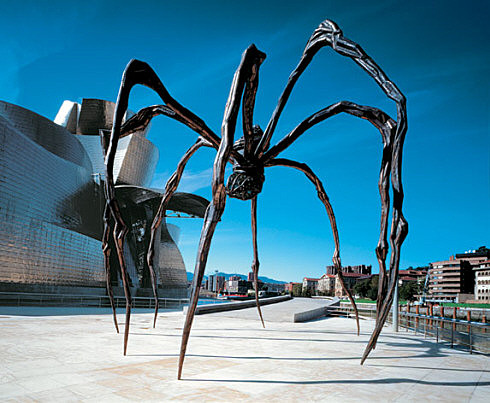
Among her best-known works are the monumental spider sculptures. The most famous, Maman (1999), towers above viewers on long, spindly legs. Bourgeois associated the spider with her mother, who worked as a tapestry restorer. The creature suggests patience and protection, but its immense scale also gives it an unsettling presence. This mixture of tenderness and unease is characteristic of Bourgeois’s work.
Cells, bodies and materials
From the 1990s onwards, Bourgeois created a series of installations known as the Cells. Enclosed spaces filled with personal objects, old furniture, fabric and sculptural forms, they invite viewers to look into fragments of an inner world. The rooms can suggest memory, confinement or refuge, while leaving their meaning open to interpretation.
Her materials were equally varied. Bourgeois worked with marble, bronze, wood, latex and found objects, and in later years made striking sculptures from fabric and clothing. Sewing and mending became part of her artistic vocabulary: acts of repair that could also point to wounds that remain difficult to heal.
Recognition and influence
Bourgeois’s work gained wider recognition over time. A major retrospective at the Museum of Modern Art in New York in 1982 introduced her art to a much larger audience. She continued working into her nineties, challenging expectations about age, artistic practice and the boundaries between personal experience and public art.
Today, Louise Bourgeois is regarded as one of the most significant artists of the twentieth century. Her work does not offer easy answers. Instead, it asks viewers to sit with complicated feelings and to consider how memory shapes the self. Through its powerful forms and emotional honesty, her art continues to connect with audiences across generations.
Louise Bourgeois: Six Tips for Exploring Her Life and Art
- Louise Bourgeois was a French-American artist, born in Paris in 1911.
- Explore how her work draws on memory, family and childhood.
- Look for themes of fear, vulnerability and healing in her art.
- Notice how she used materials such as fabric, marble and bronze.
- Her famous giant spider sculptures are titled *Maman*.
- Visit her former New York studio, now part of the Easton Foundation’s archive.
Louise Bourgeois was a French-American artist, born in Paris in 1911.
Louise Bourgeois was a French-American artist born in Paris in 1911. She became renowned for her emotionally charged sculptures, drawings and installations, which explored themes of memory, family, identity and the human body. Her long and influential career bridged European and American art, and her work continues to resonate with audiences around the world.
Explore how her work draws on memory, family and childhood.
Louise Bourgeois drew deeply on memories of her childhood and family, transforming personal experiences into art that speaks to universal emotions. Her father’s relationship with her English tutor, as well as her mother’s work restoring tapestries, shaped recurring themes of trust, betrayal, protection and repair. Rather than illustrating the past directly, Bourgeois revisited it through symbolic forms, including houses, bodies, spiders and sewn fabric. These works invite viewers to consider how early experiences stay with us, influencing our sense of identity, intimacy and belonging.
Look for themes of fear, vulnerability and healing in her art.
When exploring Louise Bourgeois’s art, look for how fear, vulnerability and healing are expressed through its forms and materials. Enclosed spaces, exposed bodies and unsettling shapes can evoke anxiety or fragility, while her use of fabric, stitching and repair suggests attempts to mend emotional wounds. These themes often sit side by side, inviting viewers to reflect on how painful memories can shape us—and how creativity can offer a way to face them.
Notice how she used materials such as fabric, marble and bronze.
Notice how Louise Bourgeois used materials such as fabric, marble and bronze to give shape to complex emotions and memories. Marble and bronze lend her sculptures weight and permanence, while fabric—often drawn from clothing and domestic textiles—brings a more intimate, tactile quality. By moving between these materials, Bourgeois created striking contrasts between strength and vulnerability, the monumental and the personal.
Her famous giant spider sculptures are titled *Maman*.
Louise Bourgeois’s famous giant spider sculptures are titled Maman, the French word for “Mum”. With their towering legs and protective yet unsettling presence, the spiders reflect Bourgeois’s complex feelings about motherhood and memory. She associated the spider with her own mother, a tapestry restorer whose patience and skill inspired the creature’s symbolism.
Visit her former New York studio, now part of the Easton Foundation’s archive.
For a closer look at Louise Bourgeois’s creative world, find out about her former studio in New York, which is preserved as part of the Easton Foundation’s archive. The space offers a glimpse into the artist’s working life and the objects and materials that surrounded her. Visits may not be open to the public on a regular basis, so check the Foundation’s latest information before planning.